
Why Homeowners Switch to Tankless
Tankless water heaters heat water on demand instead of holding 50 gallons hot all day. The honest reasons people switch:
- Endless hot water for back-to-back showers, large tubs, or simultaneous demand
- Wall-mounted, smaller footprint — reclaims floor space
- Service life of 20+ years vs. 8–12 for tanks
- Energy-efficient operation when properly sized
- No tank to leak and flood the floor
The honest reasons not to switch:
- Higher up-front install cost than a tank swap
- Requires adequate gas line capacity (or a 240V circuit for electric units)
- Hard water shortens service life unless you descale annually or pair with a softener
- Some homes do not have a vent path that supports tankless
Sizing Done Right
Tankless units are rated by gallons-per-minute (GPM) at a specific temperature rise. We measure incoming water temperature, calculate the temperature rise needed for your climate, and size the unit to your peak simultaneous demand — how many showers, faucets, and appliances might run at once on a cold morning.
Undersized tankless units run cold during peak demand. Oversized tankless units cost more than they need to. We size to your home, not a generic spec sheet, and we tell you the demand math we used.
Gas vs. Electric Tankless
Gas tankless is what most homes get. Higher GPM capacity, faster recovery, and works on natural gas or propane. Requires a gas line capable of supplying the unit (often an upsize from existing line) and a vent path (typically through the wall via concentric vent kit).
Electric tankless works in smaller homes or single-bath applications. Requires a 240V circuit and adequate panel capacity. Lower GPM than gas, but no venting needed.
Gas Meter Sizing Calculator
Most homes in our service area have a standard "250" gas meter, rated for 300,000 BTU/hr. Utilities size for real-world usage, not every appliance firing at max output at once, so the standard practice is to apply a 75% demand factor to your total connected gas load and check that against the meter's rated capacity. Check the appliances that apply to your home — typical BTU values are filled in, adjust any you know exactly.
Ballpark only — every home's actual connected load and meter condition gets confirmed on-site during your free estimate before we quote anything.
What a Tankless Install Looks Like
- Free in-home assessment: incoming water temp, gas/electrical capacity, vent path, water line condition, mounting location
- Quote flat-rate before any work, including all permits and code upgrades
- Day-of: shut off water, remove old unit, run gas/water/vent as needed, mount and commission new unit, test temperature rise across all fixtures, walk you through operation
- Permit pulled, inspection scheduled, warranty registered
What It Costs
Tankless install pricing is flat-rate, told to you up front. The number depends on:
- Unit size and brand (Rinnai, Navien, Noritz, Rheem, etc.)
- Gas line capacity (often needs upsize from 1/2" to 3/4")
- Vent path complexity
- Water line modifications and code-required upgrades
- Whether you need an electric service upgrade for hybrid or all-electric
Tankless almost always costs more than a tank-for-tank swap. The trade is service life, hot water capacity, and energy efficiency. We give you the math so you can decide honestly.
Maintenance: Descaling
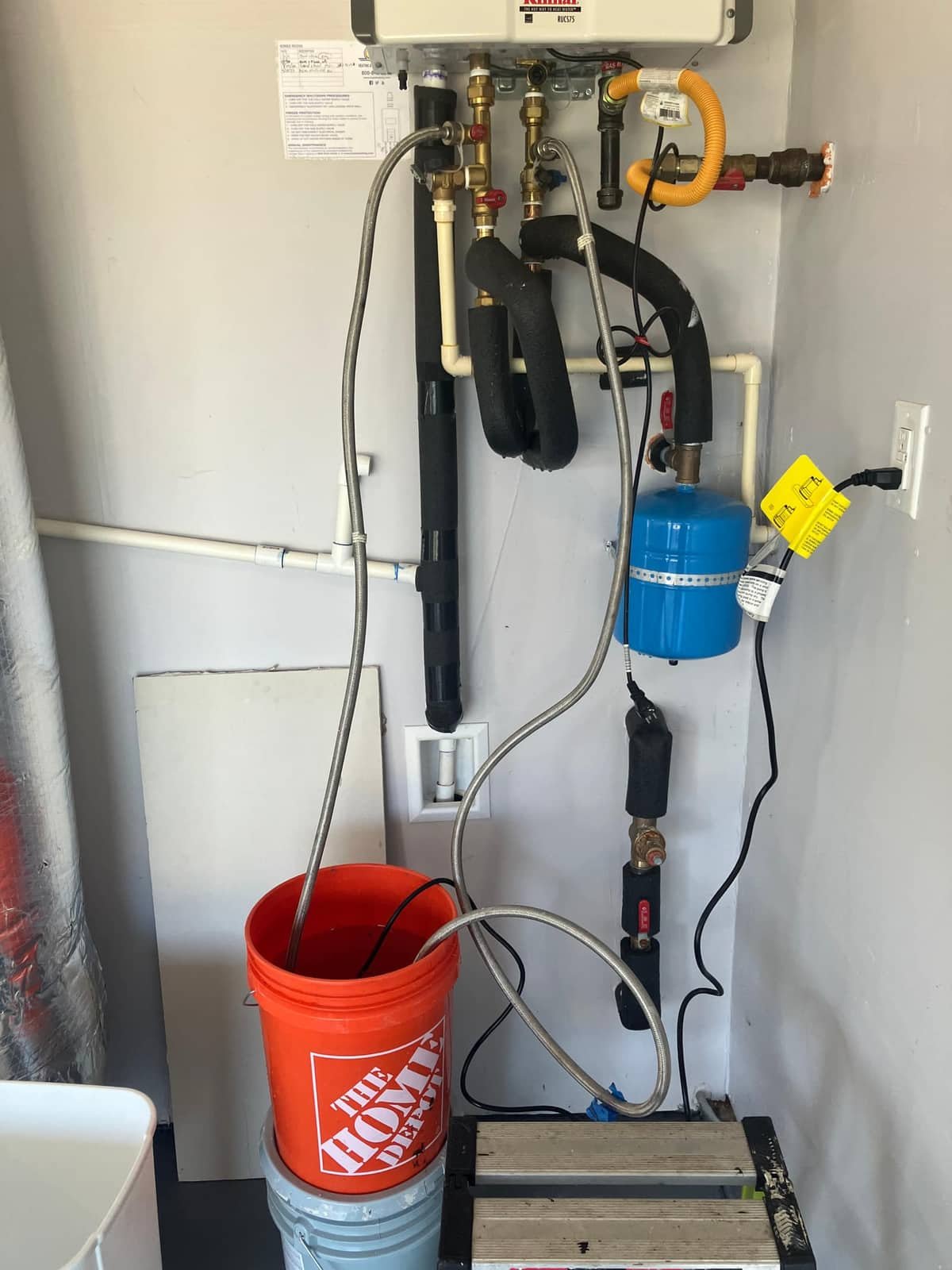
Tankless units need descaling. Pierce and South King County water has enough mineral content that scale will eventually build up on the heat exchanger and cut efficiency. We recommend an annual descale on most units, more frequently if your water is harder. We can do the descale or show you how to do it yourself.